💡
Part of the Waymark Product Story This build note explores the personal friction that started Waymark. For the full case study, including the product strategy, design decisions, launch, and iteration, start here.
The starting point: belief without clarity
As a kid, I was active in church. As I grew older, life got busy, priorities shifted, and faith slowly became more occasional than intentional. In recent years, I’ve found myself returning to Christianity, going back to church more regularly, attending worship nights, and reconnecting with my faith.
One thing has always been true for me: I resonate deeply when pastors speak during Sunday services and relate God’s Word to everyday life.
Those moments make faith feel grounded and practical.
But when I tried to read the Bible on my own, I struggled.
I believed in God, but the Bible itself often felt overwhelming. I didn’t know where to start, and even when I did, it was hard to understand how Scripture applied to daily situations like work stress, uncertainty, self-doubt, or disappointment.
That gap stayed with me.
A season that surfaced the real problem
Over the past year, life became unpredictable.
A difficult experience in a new job, a challenging job market, and moments of negative thinking pushed me close to giving up more than once. In those moments, my faith grounded me and helped me keep going, even when things felt uncertain.
Looking back, I can see God’s guidance through both the good and the hard seasons. But while living through it, I didn’t always know how to reflect, pray, or process what I was experiencing through Scripture.
The problem wasn’t belief. It was application.
Clarifying the intent
Instead of jumping straight into features, I paused and asked a product question:
What if the clarity of a good Sunday sermon could exist outside of Sunday?
Not as a replacement for church.
Not as another content-heavy devotional app.
But as something quieter and more intentional.
I defined early constraints instead of a roadmap:
One passage at a time
One real-life situation
One moment of reflection
No pressure to “perform faith”
That framing became the foundation of Waymark.
Shaping the experience
Waymark is intentionally designed to solve one pain point at a time.
Each daily lesson is short, approachable, and written in simple language. Instead of theological jargon, the focus is on meaning, context, and how Scripture connects to everyday life.
After each lesson, there’s space to respond:
Save verses that resonate
Highlight meaningful text
Journal or reflect
Close with a short prayer, if helpful
There are gentle streaks to support consistency, but no punishment for missing days. The goal is not engagement at all costs. It’s emotional safety, clarity, and honesty.
Faith should feel lived, not measured.
Building it end to end
Waymark is also the first product I’ve built entirely on my own, end to end.
From defining the product direction, to UX and UI design, writing the copy, building the app, setting up the backend, instrumenting analytics, and preparing for launch, every part of this project has been hands-on.
I didn’t wait until everything felt perfect. I learned by building, making trade-offs, and solving problems as they surfaced.
That’s how I grow as a product designer: by owning real problems and carrying them from idea to execution.
Choosing progress over overthinking
One idea stayed with me throughout this process, from My Indie Book by Tony Dinh:
“Ship, and don’t overthink.”
That line became a quiet reminder while building Waymark. Instead of waiting for perfect clarity or confidence, I focused on shipping something real, learning from it, and improving through feedback.
Waymark exists today because I chose progress over hesitation.
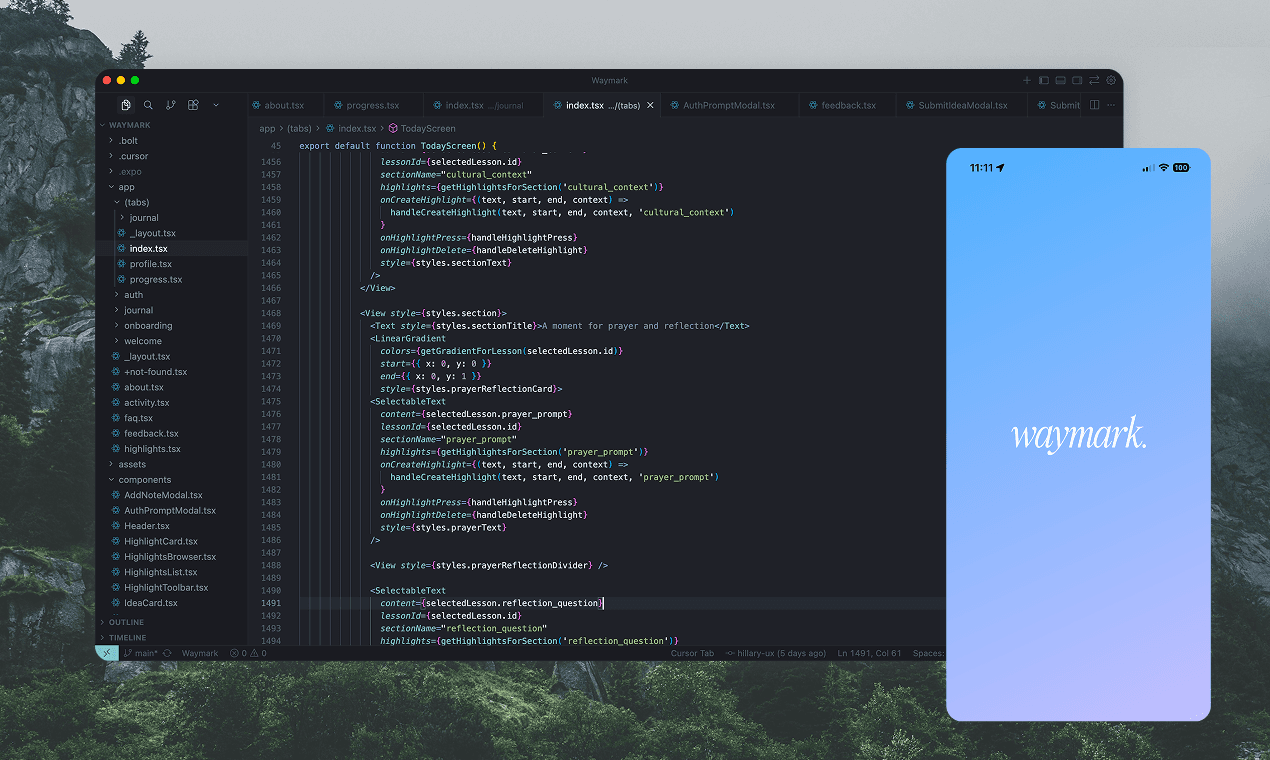
How it’s built (and why)
Waymark is currently built for TestFlight beta testing, with early testers joining soon. The public waitlist is live at www.getwaymark.app, and the beta is planned within the next one to two weeks.
The stack is intentionally pragmatic:
React Native
Expo
TypeScript
Supabase with PostgreSQL
Google OAuth
PostHog for analytics
Figma for design
Cursor and ChatGPT for AI-assisted development and thinking
Bolt for rapid prototyping
The tools matter, but the mindset matters more. I care about building something usable first, then refining it through real feedback.
Why this project matters to me
Waymark isn’t just a faith app.
It represents how I approach product design: start from real human friction, design with restraint, build thoughtfully, and learn by shipping.
I’m drawn to problems that are emotional, human, and often overlooked. Problems where clarity matters more than speed, and empathy matters more than scale.
One week in, Waymark already feels like proof of how I work.
🚀 What’s next
Waymark is preparing for its beta release on TestFlight.
If this story resonates with you, you can:
Join the beta waitlist at www.getwaymark.app
Support the launch on Product Hunt
Or simply share feedback on the idea itself

I’m learning by building, and I’m building by listening. That’s how Waymark came to life, and that’s how I intend to keep working.